



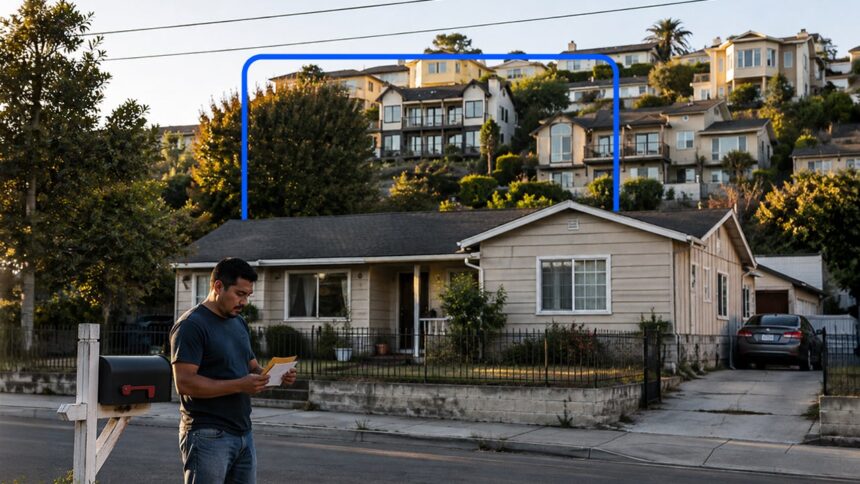
The moment Runbo Li’s parents bought his childhood home is one he will never forget.
In 1998, his parents immigrated from China to build a better life for him and his sister. For nearly a decade, they lived carefully, saving as much money as they could while working at Penn State.
In 2006, their persistence paid off. My parents each earned about $30,000 and bought a newly built home in State College, Pennsylvania, for $180,000.
Their income did not increase much over time. They survived two market downturns and a period when they owed more than their home was worth. They took on side jobs to make ends meet and even used their home equity along the way. But the parents continued to move forward and paid off their mortgage in full by 2020.
For many low-income families, stories like this capture what homeownership means: stability, security, and a path to something better. The homeownership rate for low-income households (those with incomes below $30,961) has increased since 2015, outpacing even higher-income households, according to the Minneapolis Fed.
This house is a representation of all the sacrifices they went through. It’s as if we have packed all our hardships, whether it be financial, living, or social, and accumulated them and exchanged them for something physical.
— Lambo Lee
But Lee’s family story is more the exception than the norm. What happens to many low-income people after they buy a home is much more complex. While housing equity is the largest asset for low-income households, low-income households often lag behind in building wealth, building wealth more slowly and with less stability than higher-income owners. For many families, the challenge is maintaining that wealth and building within a system shaped primarily by factors beyond their control.
Falling home values, slowing stock growth
Homeownership is considered one of the most reliable means of building wealth. However, the reality is not the same for everyone.
From 2012 to 2022, the median price of homes owned by low-income households rose 75% to $98,910, according to the National Association of Realtors (NAR). Although this is an impressive growth rate, the resulting dollar value is $23,000 less than the price of a home for a middle-income family ($122,100) and nearly $52,000 less than the price of a home for a high-income family ($150,800).
Although the median value of homes owned by low-income households has increased at a higher rate than that of middle- and high-income households, their dollar value has lagged far behind. It’s a basic math problem.
| starting home value | % growth | dollar-based growth | Housing end value |
| $100,000 | 60% growth | $60,000 | $160,000 |
| $125,000 | 55% growth | $68,750 | $193,750 |
| $150,000 | 50% growth | $75,000 | $225,000 |
“The main reason for that is that they (low-income homeowners) tend to own lower-value homes,” said Nadia Evangelou, senior economist and director of real estate research at NAR. “Once they enter the market, they are not able to accumulate the same wealth as other income groups. High-income groups tend to own homes in expensive areas, so they can build wealth faster. Unfortunately, they (low-income homeowners) cannot afford to buy homes in these areas. So location is important.”
Low-income and high-income households alike face rising costs of daily living such as gas, groceries, and medical costs, but their largest assets are not returning equivalent dollar value. Thus, already wealthy households increase their wealth more rapidly, while low-income households fall further behind, even at impressive growth rates.
Years of service penalty for low-income households
Low-income homeowners also find themselves in the wrong era. Common advice is that the longer you live in your home, the more equity you’ll have as the value of your home increases over time. This is true for both low-income and high-income homeowners, but the numbers again do not favor low-income households.
Low-income homeowners, who live in their homes an average of 19 years, the longest of any income group, walk away with an estimated value of about $100,000 less than higher-income homeowners who live in their homes for just 14 years.
| income group | home ownership rate | Median asset value | median household income | Increase in estimated wealth due to price increase | I’ve been in the average house for years. |
| Low income (less than 80% of median) | 48.1% | $272,736 | $35,168 | $156,856 | 19 |
| Middle income (80% to 200% of median) | 70.1% | $356,318 | $102,734 | $169,956 | 16 |
| Top income (200% or more) | 86.9% | $537,752 | $229,467 | $254,625 | 14 |
sauce: National Association of Realtors/2024 American Community Survey Public Use Microdata Sample
An uphill gateway to homeownership
Building equity begins before homeowners even receive the keys. It starts with the amount you bring to the table, the down payment. Therein lies another challenge to building equity for many low-income homeowners. The key is to raise even a small amount as a down payment. Not only does this limit the price of your home and the types of neighborhoods you can access, but it also affects how much equity you can build.
And even if these families are able to obtain homeownership, the challenge of building equity does not disappear. Lee’s parents learned firsthand that the housing downturn can quickly wipe out any gains made.
Just two years after they bought their home, the 2008 financial crisis hit. The value of his parents’ home plummeted and they spent some time underwater. Lee said there was a further small recession after that. While his parents’ home prices have nearly doubled in the past 20 years, “they haven’t gone up as fast as they could have if the timing had been a little better,” he says.
Stephen Ross, an economics professor at the University of Connecticut, said the economic losses faced by homeowners after the Great Recession were mainly due to two factors. One is the loss of down payments and slower-than-expected growth in home values over time.
“We may be concerned about encouraging more economically vulnerable people to move into homeownership because of these long-term risks,” he says. “The idea is that they would never have accessed the capital gains on the home if they hadn’t moved into homeownership anyway.”
Leverage your assets
Slow capital growth can leave low-income homeowners in a precarious position. If you want to sell and upgrade to a bigger home, you don’t have much of a cushion. Because housing does not easily provide a financial buffer, accessing housing equity for emergencies such as medical bills or unemployment becomes even more difficult. Refinancing can also be difficult, and you may be locked in with low equity as well as high interest rates.
Still, some low-income homeowners are finding ways to overcome these challenges.
Evangelou cited data from the 2024 Mortgage Disclosure Act (HMDA) showing that 33% of mortgage originations for households with incomes between $30,000 and $40,000 were refinances. This is higher than the 22% to 23% refinance rate for middle- and high-income homeowners.
“This suggests that low-income homeowners are more likely to tap into their home equity or adjust their loans to manage financial hurdles,” she says.
Home equity often acts as a forced savings account for low-income households. Their stock will accumulate slowly over time, but eventually, once they have access to it, it will become an important source of capital movement.
“For the past 60 to 70 years, people have been able to pass on family wealth to their children in order to step up financially,” said Anneliese Lederer, senior policy advisor at the Center for Responsible Lending, a nonprofit research and policy advocacy group. She explains that when someone is locked out of homeownership, they are cut off from a major source of wealth that can grow over time.
In the late 2000s and 2010s, Lee remembers her parents working around the clock. There were long stretches of time when he hardly saw them. His mother worked around the clock at Penn State in the mornings and at a restaurant in the evenings. Their efforts finally paid off. Around 2020, his parents were able to leverage their home equity to invest in an apartment and even buy a small hot pot business.
“Starting a business has always been a dream for them and trying to do something bigger,” Lee says. “Now that the repayments for the house are almost complete, we can build a house with peace of mind.”
A tough road to the next generation
Homeownership remains one of the most powerful tools for building wealth in America. For low-income households, it’s even more important.
“Low-income households typically do not have access to the same size of other assets, such as stocks or retirement accounts, as other income groups, so they rely more on homeownership as a wealth-building tool,” Evangelou says.
For low-income households, the idea of long-term financial security can be difficult to make a reality.
Bank Rate Analysis found that someone earning the median income in the U.S. ($80,000) can afford to buy three out of four U.S. homes on the market. As of March 2026, the median home sales price in the United States was over $408,000. This has prevented many people with limited incomes from building wealth through homeownership or stocks.
“Mortgage costs are rising and prices remain high, which puts a huge burden on people who didn’t already own a home,” said Eric Hembre, senior economist at the Federal Reserve Bank of Minneapolis. “In particular, we’re seeing a significant decline in people’s access to homeownership, especially low-income families.”
For Lee, this reality is somber as he reflects on his parents’ accomplishments.
“It’s pretty impressive that we were able to do that in 2006 even though we didn’t have that much income,” Lee said. “You’re talking about a situation where their income basically didn’t increase that much after that. I think it would have been much more difficult for them to try to do that today.”
The purchase ultimately paid off for Lee’s parents. The house, which has been paid off, will eventually be passed on to him and his sister as an inheritance. By watching their experiences, he learned a lot about home ownership. The challenges of building equity, the ups and downs of home values, the pressure to keep up with mortgage payments, and more. Lee has been renting for 13 years and is in no rush to buy a home.
“It feels very far away to me,” he says. “I think I’m more likely to think about it when I’m trying to settle down. Maybe I’m married and I’m thinking about kids and I know where I want to live. But those are all really big things that I’m far away from.”