



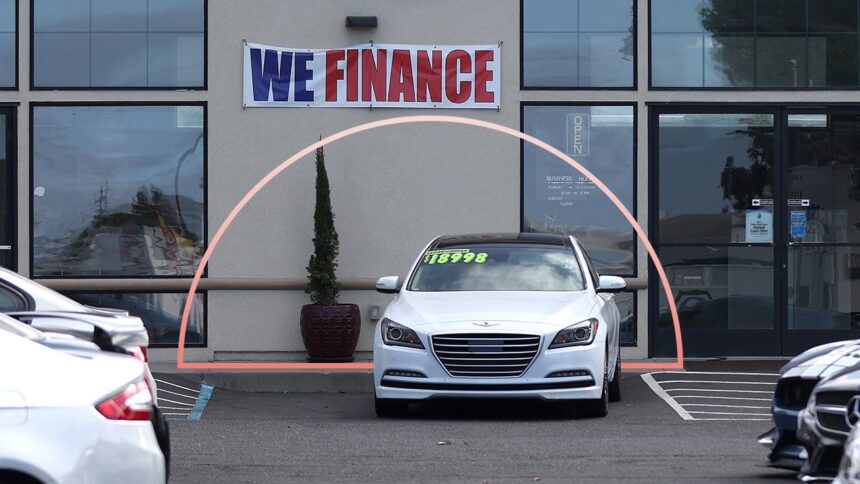
This is a story about predatory loans that can ensnare you in a matter of hours, rack up years of debt, and possibly damage your credit.
It’s also a story about how completely legal it is.
Our report shows that more consumers are being targeted for auto loans, which are subject to far less scrutiny than other financing products. Consider: A record number of people are delinquent on their auto loans, overall delinquency rates are at a 15-year high, and foreclosures increased 43% between 2022 and 2024. These signs of consumer tension are, in part, the result of rising vehicle prices and changing eligibility standards.
Reputable dealers and finance companies, which also originate millions of high-value auto loans each year, rejected 15.2% of loan applications last October, double the 6.7% reported in June, according to the New York Fed. But less reputable lenders, or “buy here, pay here” used car dealers, continue to offer predatory but legitimate loans, especially to consumers with subprime credit. We know this because the average APR for auto loans granted to borrowers with credit scores below 600 continues to hover around 20%, similar to credit cards, according to the latest data from Experian.
At Bankrate, we’ve interviewed car buyers, advocates, lawyers, and industry insiders to better understand how dealers exploit unsuspecting consumers for commissions. We think this is something you should know so you know what you might be facing the next time you finance your car purchase.
consumer experience
Until April 2024, Tori Holmesley had never owned a car that was in top condition. So when Holmesley, 50, received an email saying she was pre-approved from Drivetime, a local used car dealership with locations across the country, she thought it was her lucky day. After all, she needed a reliable vehicle to drive to clients for her job as a home care aide.
“Just walking out in the morning starts something,” says Homesley, who previously spent hundreds of dollars on a beater and more recently $1,500 on a late-model 2008 Dodge Ram pickup. “And I didn’t look into it myself…I always rented everything or paid in cash, you know?”
Holmesley went to the location, selected a 2020 Chevrolet Equinox, and financed it through DriveTime’s financing partner, Bridgecrest. She later learned that she had agreed to repay the loan amount that exceeded the value of the car at 20% annual interest.
Read more about Homesley’s predatory loan deal.
“They saw me coming from a mile away,” said Holmesley, who lives in a rented RV in Azle, Texas, and works 40 to 70 hours a week.
Despite paying on time, Holmesley is now “upside down” on the vernal equinox. Her lender came to a foregone conclusion:
- Sticker price ($21,695) $7,000 higher than what you’d expect to pay online for this model with comparable miles at the time (76,080)
- Incorporate $4,465 worth of optional “add-ons” into your loan balance that you didn’t fully understand, such as non-essential gap coverage and guarantees.
- She was able to close the deal with a down payment of 3.6% (much lower than the 10-20% typically recommended by experts)
- Questions have been raised about whether the terms meet the National Association of Consumer Advocates’ (NACA) predatory lending standards, which include using “deceptive or unethical means to persuade a person to accept a loan on unfair terms.”
Unfortunately, the problem here is that a 20% APR is the average cost of doing business for consumers with subprime credit, according to Experian.
| FICO score | new car loan | used car loan |
| Deep subprime (300-500) | 15.85% | 21.6% |
| Subprime (501-600) | 13.34% | 19% |
| Near prime numbers (601 to 660) | 9.77% | 14.11% |
| Prime (661-780) | 6.51% | 9.65% |
| Super Prime (781-850) | 4.88% | 7.43% |
Source: Experian Auto Finance Market Status (Q3 2025)
A few years ago, Holmesley, a homeless single mother of two children, was struggling to maintain her credit score. She said her credit score was around 525 at the time she rented from Bridgecrest. But now, no reputable lender will refinance her underwater Equinox, even though her credit score has climbed to the mid-to-high 600s with the help of a credit counselor.
John W. Van Alst is a senior attorney at the nonprofit National Consumer Law Center (NCLC), where he has worked for nearly 20 years. He is also the director of NCLC’s Working Cars for Working People project, which partners with nonprofit organizations to help low-income Americans obtain cars for free or at relatively low cost.
Van Alst was not at all surprised to hear Holmesley’s story.
Lender’s perspective
DriveTime isn’t the only used car dealership in the U.S. that pushes its funding partner Bridgecrest onto unsuspecting or unprepared car buyers. That’s the stakes, and that’s why it’s so important for salespeople to come to the dealership with outside funding out of necessity.
However, DriveTime and Bridgecrest are both owned by DriveTime Automotive Group, Inc., so they work together as a “buy here, pay here” lender. This is a term used to describe used car dealers who both sell and finance vehicles, usually at higher interest rates and less attractive terms for consumers, regardless of their credit score. Bankrate reached out to DriveTime and Bridgecrest to learn more about their side of the story, but they did not respond to multiple phone calls and emails dating back more than a month to publication.
And if you think “buy here, pay here” is just another realm of shady locally owned and operated businesses that most of us know to avoid, just consider the scale of the companies involved in Homesley’s troubled situation.
Yossi Levi, founder and CEO of online trade publication Car Dealership Guy, said Bridgecrest is “a large, privately owned company, one of the nation’s largest used car retailers, a buy here, pay here dealership.” “So I think they have more flexibility when it comes to financing because they’re obviously a privately owned company.
“I don’t want to talk about Bridgecrest, because I don’t know how they run their finances. What I’m saying is, they’ve been around for decades at this point, and that shows they’re solving a need in the market. They have competition, they don’t have a monopoly. So if they don’t have a decent quality product on the market, I would hope that they wouldn’t be sustainable and would go out of the business.” ”
Therein lies the free market argument that industry experts like Levi have heard ad nauseum. So, while one might suspect that lenders are preying on less financially savvy consumers, lenders exist and are likely to fill holes in the ever-expanding banking desert and serve consumers who would otherwise be underserved. This means that an unbanked and possibly uninformed person is likely to get a higher annual interest rate on a car loan than someone who lives next door to a credit union or a name-brand car dealership. (And buy-here, pay-here bank deserts may be reinforcing each other. If you’re struggling to pay off a predatory-but-legal car loan, damaged credit can make it difficult to go to a bank somewhere safer.)
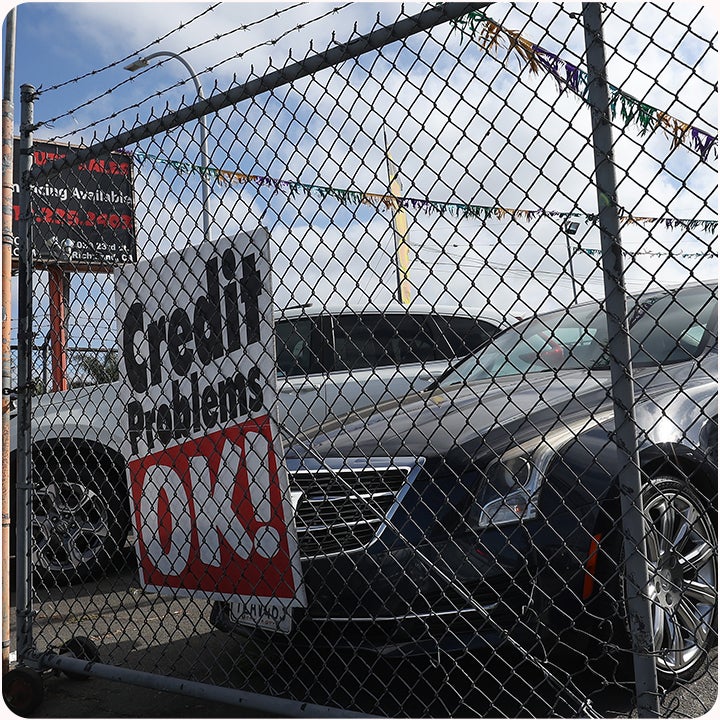
Consumer advocates agree that dealers that operate ethically face far more scrutiny than those that don’t, especially if they’re a big brand and sometimes because they have shareholders. For such high-profile dealers, taking out car loans they can’t afford isn’t good business, Levi said.
“Even if you’re not a righteous saint, it’s in the customer’s best interest to buy something affordable, because it means you can successfully repay that loan…otherwise you’ll come back to me to buy another car,” he added.
Mr. Homesley’s own credit counselor, Todd Christensen, acknowledged the nuances inherent in subprime lenders, saying, “They’re not all scammers.”
“Certainly they’re working with a very high-risk population,” Counselor added, referring to car buyers like Holmesley who don’t have fair or better credit. “The higher the risk, the higher the interest, because they have to do it[to make a profit]. But it feels absolutely predatory.”
One wonders what kind of interest rate Homesley would have been given if her credit score had been lower.
“Twenty percent good “I’ve seen 35% annual interest rates on auto loans,” Christensen says.
How parking fees are lost in parking lots
Imagine yourself on the premises. You may be trying to trade in your current car and negotiate the price of your next car at the same time. You’re also worried about whether your new car payment will fit within your budget. On the other hand, you may be able to avoid expensive but unnecessary add-ons that are pushed on you by salespeople.
It’s easy to lose focus on big priorities like interest rates.
“You really come in with your hands tied behind your back,” Van Alst says. “You can’t keep all of these front and center at the same time.”
Dealers, on the other hand, do things like this every day. Once they understand what you’re interested in, like your monthly payments, car value, trade-in value, etc., they can adjust other terms of the deal to work against you. Oh, and want a lower car payment? Extend your loan term.
“Many consumers don’t understand that when they walk into a car dealership, which is true for many, if not all, dealerships, their objective is to extract as much profit as possible from every aspect of the transaction,” said Dan Brin, an attorney who handles auto claims in Connecticut and Massachusetts.
Brin compares it to buying a toaster oven from Walmart, but it’s usually a worry-free transaction because you don’t have to worry about paying more than other customers.
Walmart is “not going to rate you, it’s not going to judge how gullible you think you are, and it’s not going to try to find out what could be creeping in there that you might not know about,” Brin continues with the example. “And a lot of people walk into a car dealership thinking it’s the same thing, but that’s definitely not the case. It’s an environment where the other side has all the information, they have all the influence, they have all the experience in doing these types of transactions. And consumers who don’t have the knowledge and don’t have the ability to protect themselves can be taken advantage of very badly.”
Buying a car always seems stressful, but not all dealerships add to the stress in the same way. Still, the villains and their actions have caught the attention of Van Alst and NACA Senior Policy Director Christine Hines. Predatory tactics used by dealers include:
| tactics | detail | analysis |
| interest rate increase | When you give some of your credit information to a financial institution, they will give you a “purchase rate,” or the rate at which they are willing to purchase a loan. Dealers charge higher interest rates to car buyers and split the additional interest 50-50 with the financial institution that underwrites the loan. | “This can also be very abusive and discriminatory, because you get to choose who and how you charge these markups,” Hines says. |
| interest rate fraud | If dealers risk losing money by selling car buyer loans to subprime lenders, they try to make more money by raising the car’s asking price above market value. | “So once the dealer has complete control over the transaction, it becomes very easy to hide some of this financing cost in the price of the car,” Van Alst says. The higher the price of a car, the more sales tax the buyer will pay. |
Imagine yourself back at the dealership. You chose a car, negotiated the price and, sure enough, successfully avoided unnecessary additional options offered by the salesperson. After that, a “cascade” of paperwork begins, says NCLC’s Van Alst. Once the first adjustment is complete and you start, you’re suddenly asked to quickly read everything, sign here, initial there. A new loan agreement, digital or not, is just a piece of paper shuffled into a pile.
Yes, the Truth in Lending Act states that when you obtain credit, you must disclose its costs so you can shop around. But “you never get it until the end, so it’s like you’re already locked in,” Van Alst says. “And the reality is that this is a very opaque and hard-to-manage transaction, so time and time again we see horrific abuses built into this transaction.”
In Ms. Homesley’s case, she admits she didn’t understand what the APR meant when she signed it. She certainly didn’t understand that her loan amount was inflated not only by the car’s sticker price, but also by additional charges. This raises the question whether her signature was a substitute for consent. In 2024 settlements in states such as Illinois and Rhode Island, attorneys general specifically accused dealers of failing to obtain customers’ “explicit” and “informed” consent.
Like others, Holmesley was more concerned about short-term costs.
Lisa Cameron has been involved in credit counseling in some capacity for 32 years. She recently visited some of the retailer’s websites to double-check their products.
“The banner at the top said, ‘What do you want to pay?'” says Camerson. “So, again, maybe someone on a tight budget would focus more on that part and not worry as much about what the long-term costs would be because of the higher interest rates. They were just worried about where the first payment would fit into their budget.”
“So this is a complex process and it’s not always easy to navigate. I don’t know if I would have known what to look for if I wasn’t in this industry.”
Lack of regulation shifts responsibility for enforcement to consumers
For many of us, a car is the second biggest purchase we’ll ever make. But that can happen within hours, and it can take months to get a home and get a mortgage.
Consider the example of a homebuyer education course mandated by the Department of Housing and Urban Development for first-time homebuyers (for the first time in a while). We all have to get through this in order to qualify for homebuyer grants and down payment assistance, as well as learn about how APRs work and negotiable fees. It makes sense to put this process in place before making any life-changing financial decisions.
No such process exists in the auto loan industry. This is despite the fact that for many Americans, a car is a necessity, like a roof over their head. Needless to say, car loans are much smaller than home loans, but they’re usually in the five-figure range. If you struggle with repayments, it can easily affect your financial future.
Currently, car financing has fewer red tape than home loans (and other types of financing). Part of the reason is that bad actors are not contributing to causing economic crises (see the Great Recession of 2008). It is also due to gaps in regulation and enforcement at both the state and federal levels.
regulation and enforcement
With the Consumer Financial Protection Bureau (CFPB) starving, tighter auto loan regulations are unlikely to happen anytime soon. You might attribute this fact to political change in Washington, D.C., but it’s actually been happening for years, since the Great Recession of 2008.
“Dealers have a very strong lobbying force in Congress,” says NACA’s Hines.
In fact, Hines added, these forces, including the National Automobile Dealers Association and the National Independent Automobile Dealers Association (NIADA), which did not respond to Bankrate’s interview requests prior to publication, persuaded Congress that auto dealers should be exempt from CFPB oversight. The CFPB had a record of enforcement actions against certain types of auto lenders up until the second Trump administration. And nearly 15 years after the enactment of the Dodd-Frank Act that created the CFPB, the agency’s new leadership has indicated that it should also not be responsible for overseeing auto lenders.
Consider that NIADA represents approximately 40,000 licensed used car dealers across the country.
| Key moments in auto loan regulation | |
| May 2020 | A group of 34 state attorneys general announced a $550 million settlement with Santander, a lender that “knew there was an unacceptably high probability of default” on subprime auto loans. |
| January 2024 | The FTC has failed to implement the CARS rule aimed at combating retail auto fraud. |
| August 2024 | The CFPB is proposing to reduce its oversight of auto lenders across the country. |
| October 2025 | California passed the CARS version into state law in its most recent legislative session. |
In any case, much of the auto loan regulation is done at the state level, not the federal level. Most notably, the maximum (or allowable) auto loan APR that a dealer can charge depends on factors such as the loan size and the age of the car, in addition to your state’s usury laws.
“This is difficult because in many cases it’s small dealers and sometimes small financial companies,” Van Alst said. “So I understand that it’s a tough job for enforcement agencies, whether it’s state agencies or the CFPB or the FTC. But it’s very necessary to actually try to police the market.”
The NCLC released a state-by-state review of laws aimed at prohibiting unfair and deceptive lending practices in 2018. Bankrate is currently working on an updated analysis that will broadly measure which states are most effective at protecting consumers. Below are some examples of states that are more aggressive than others in promoting regulation.
| state | timing | execution | settlement |
| arizona | August 2024 | Coulter Motor Company has been criticized by some for charging high interest rates to Latino car buyers. | $2.6 million |
| illinois | December 2024 | Among other violations, Leader Automotive Group allegedly charged buyers for expensive add-ons without their consent. | $20 million* |
| maryland | March 2025 | Darker’s Honda was sued for charging fees for options that could be included in the loan. | 3 million dollars |
| rhode island | August 2024 | Six local dealers reportedly attempted to charge for additional warranties not included in the advertised price. | 1 million dollars |
| *This is the largest settlement the FTC has ever obtained from an auto dealer in cooperation with a state. | |||
Levi, CEO of industry platform Car Dealership Guy, argues that stronger regulation is not an easy solution. He said that if auto dealers hit the state’s allowable interest rate, they are typically charged higher acquisition fees by banks that may take on the risk of subprime loan underwriting. This could reduce dealers’ incentive to sell cars and reduce the opportunity for subprime borrowers to buy cars from reputable dealers.
“So the question is, what’s better?” Levi asks. “Is it better to cut off access to traditionally expensive off-market loans? Or is it better to continue offering loans anyway, knowing that certain consumers may not be educated enough to make good decisions?”
Consumer burden
By her own admission, Holmesley lacked the knowledge and understanding to make better borrowing decisions. She didn’t blink when the Bridgecrest financing showed her that she would be paying $296.44 twice a month instead of the usual one that most car owners are accustomed to.
A month after borrowing, Homesley realized the predatory nature of the new loan and contacted Bridgecrest to inquire about the possibility of refinancing. They told her they would refinance it for $1,000, but she didn’t have that cash. She only made a $1,000 down payment on the car.
If you think it’s unfair to hold someone like Homesley responsible, multiple consumer advocates will agree with you. Still, absent sensible regulation and enforcement, the rest of us can at least try to make the most of a disadvantageous situation.
Take Holmesley’s story as a warning.
| Homesley movement | Advice on bank rates |
| Worked with a nonprofit credit counselor to improve credit score | Of course, in addition to that step, you can also consider DIY credit improvement if necessary. |
| You trust the dealer or seller to accurately price your new vehicle. | Calculate your car’s value more objectively with tools like Kelley Blue Book |
| Depends on dealer financing partner and recommendations |
Check out interest rates and terms with your bank, credit union, or online lender before stepping foot on the lot. |
| Accepting nearly $5,000 in additional dealer fees, her loan amount ballooned. | Ask seriously and probably decline any add-ons you think you don’t need |
| I made a 3.6% down payment without having enough budget. | If possible, budget for and save for as large a down payment as possible, ideally 20% or more. |
Of course, Homesley also decided to buy here, pay the lot here, and buy the car from the lender. However, experts unanimously agree that this should be a last resort.
“In fact, we encourage consumers to look to the private market. If you’re buying a used car, you don’t have to buy from a dealer,” says Rosemary Shahan, president of Consumers for Auto Reliability and Safety®, which supports California’s recently passed CARS law. “You can also buy from private parties. That market has its own potential pitfalls to be careful of, but here are some tips for consumers.”
Ms. Homesley understands the importance of always being more prepared when making financial decisions, especially in the auto finance industry, which is willing to finance debts that are difficult to repay.
“Educate yourself in every way you can, anything that has to do with your finances,” Homesley says, including advice for her two daughters. “Because there’s a lot of people out there trying to trick you, and there’s a lot of red tape and stuff…You can quickly feel like you’re really stupid, and you’re going to be in a much worse situation.”
Have you already experienced a failed car purchase? Submit your details Complaint to CFPB And then to F.T.C.says Hines. “(Your) problems may not be solved right away, but a record will be built,” she added. “Then other state officials, state attorneys general, other state financial institutions, other officials across the country will have access to that information.” If you’d like to share your story with us, email [email protected].