



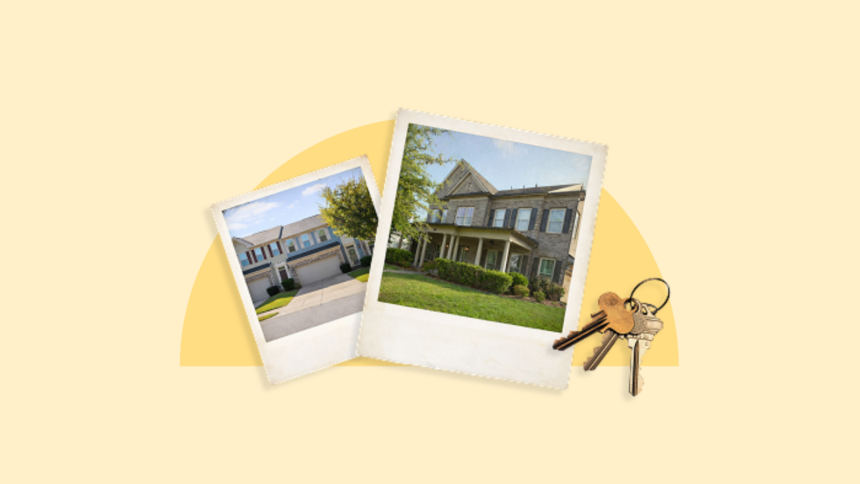
Kelly and Steven Auslander had what millions of people wanted: mortgage rates of less than 3%.
To be exact, it is 2.375%.
But they gave up on it. why? The biggest reason was space. Their first home was a small townhome and now they have a growing family. “We also wanted to move to a nearby area with better schools, and now we would be closer to family, which was very important to us,” says Kelly Auslander.
The conventional wisdom that homeowners are locked into low mortgage rates is changing. People need flexibility. They need to be able to move around for work, family, and livelihood. These factors often outweigh the so-called lock-in effect, especially as we move away from the ultra-low interest rates of the past.
Elizabeth and Chris Vanstee recently decided to forego their 3.6% mortgage rate and take out a new 6.5% mortgage for a new home about 25 miles away. Chris has a new job with a longer commute, and Elizabeth’s job has moved back to the office, so they both want to live closer to work.
“Other factors were that we were looking for a home with more outdoor space and access to nearby nature, and we found a home we really liked, so it made sense,” says Elizabeth.
Amanda Thompson, who lives in Buffalo, New York, plans to move to the Orlando, Florida area soon, despite current mortgage rates of 3.2%. why? She is tired of seeing snow and wants to change her lifestyle. “I’m willing to pay a little more for happiness and bigger and better opportunities,” Thompson says.
Indeed, the lock-in effect is a reality for many homeowners. But how long will it last? Homeowners will need to consider the trade-off between today’s low interest rates and a new life elsewhere. Bankrate analyzed data from the Federal Housing Finance Agency (FHFA) and spoke to real estate agents and home sellers to understand how lock-in effects are changing.
Slow erosion of lock-in effects
The lock-in effect resulted from mortgage rates hitting rock bottom between 2020 and 2022, and many homeowners who refinanced or bought at low rates found themselves unable to afford to move. Moving means giving up your current low mortgage rate for a higher mortgage and possibly a more expensive home. But the further we move away from the era of rock-bottom interest rates, the more people buy at higher rates, and the lock-in effect slowly erodes.
In fact, FHFA data shows that by 2025, the number of mortgage holders with interest rates of 6% or higher will exceed the number of mortgage holders with interest rates of 3% or less. Additionally, the average interest rate on mortgages in force rose slowly from 3.8% in 2022 to 4.4% in 2025, close to the average interest rate in mortgages in 2019 (4.5%).
The average 30-year mortgage rate in February 2026 was 6.15%, the lowest rate for February since 2022. However, interest rates rose slightly as inflation concerns took hold and the Iran war affected global oil supplies.
Mike Fratantoni, chief economist at the Mortgage Bankers Association, said in a statement after the Fed’s March 17 and 18 meetings that “long-term interest rates account for higher inflation and the lower likelihood that the Fed will cut rates further this year.” “We expect mortgage rates to be in the 6% to 6.5% range this year, with the latest weekly data showing a trend toward the higher end of that range.”
Odeta Cusi, deputy chief economist at First American, said the data shows life continues for many people who are waiting on the sidelines to be moved.
“Even if interest rates don’t come down significantly from here, we’re already seeing the lock-in effect ease over time as life events (new job, growing family, downsizing, divorce, retirement) cause people to move regardless of interest rates,” Kushi says.
The housing market is already steadily “unfreezing”.
— Odetakushi
Deputy Chief Economist, First American
The strength of lock-in varies depending on where you live
The low interest rates that keep people from selling don’t look the same everywhere. While it is easy to take a national average and apply it broadly, certain regions are more affected by this effect.
“What we found in our research is that a lot of the really low-interest mortgages are concentrated in the West, California, and very expensive markets,” said Hannah Jones, senior economic research analyst at Realtor.com. “If you have a large loan, there is more incentive to refinance at a very low interest rate, and there is more incentive to maintain that rate.”
Let’s illustrate this. Here we show the difference in principal and interest (P&I) payments for the national median existing home price and California median home price for mortgage rates of 3% and 6%. For this exercise, we assumed a 20% down payment.
| pay at 3% interest | pay at 6% interest | difference in payment | |
| National median existing home price – $405,400 | $1,367 | $1,944 | $577 |
| California median home price – $850,680 | $2,869 | $4,080 | $1,211 |
If mortgage rates increase from 3% to 6%, monthly P&I payments for a median-priced California home would increase by $1,211. This is more than double the national median housing increase. In one year, California homes cost $7,608 more than the national median home.
This lock-in penalty applies not only to California but to all high-cost markets, mostly along the coast. Conversely, many markets in the Midwest and South are weaker than average.
When you factor in the added costs of buying a new home, such as property tax reassessment, it’s easy to see why homeowners in more expensive areas are less willing to sell. This is reflected in the data. The First American report says homeowners in expensive states are more likely to be locked into low interest rates, causing housing markets to become even weaker starting in 2022.
No matter where you live, if your budget allows, you should consider a mortgage. This advice is even more true now, when interest rates are higher than they were just a few years ago.
For now, some people are selling while waiting to buy.
If mortgage interest rates remain as they are, some people selling their home may not be interested in taking out a new mortgage. This is especially true for downsizing or relocating out of state.
Sarah Ricane and her family chose to sell their home in Jacksonville, Florida at a 2.75% interest rate and move to Pittsburgh, Pennsylvania to be closer to family. They chose to rent instead of buy to learn more about the area. “We didn’t have to go through a lot of hoops to move if we ultimately didn’t think the area or neighborhood was the best fit for us,” Li-Cain says. Renting also allows families to live in areas with strong school districts that they might not otherwise be able to afford.
Rent prices are falling in many metropolitan areas. Meanwhile, home prices remain high due to a lack of supply, Realtor.com’s Jones said. For some people, renting is a lifestyle choice over homeownership. We also hedge risks, especially in regions prone to extreme weather events and other high costs.
After all, homeownership is expensive. In addition to principal and interest, there are many other expenses. According to Bankrate’s 2025 Hidden Costs of Homeownership Study, it’s more than $21,000 per year.
Staying on the sidelines comes with risks.
Economic uncertainty has many people waiting until the right time to sell or buy a home. But indecision comes with downsides, both financially and personally.
“Staying on the sidelines can be risky,” Cusi warns. “In inventory-constrained markets, falling interest rates may be met with higher prices as more buyers re-enter. Buyers who wait may secure slightly lower interest rates, but end up borrowing more, wiping out their monthly payment savings or And because buying or selling a home is not a purely financial decision, putting it off for too long can mean putting off important life choices like more space, shorter commutes, better schools, care needs, and overall quality of life.”
For those playing the waiting game, the best thing you can do is make a plan, Jones advises. That means saving for a down payment and improving your credit. The good news is that things are looking up for buyers. Interest rates remain lower than they have been for most of the past three years, and prices are softening in many markets.
“Buying a home always feels expensive,” Jones says. “Purchasing a home will still feel expensive, but buyers are taking a little bit more of a driver’s seat than they have in recent years.”
If the market becomes more favorable to buyers, more people may be able to get out of low-cost mortgages and into new homes.